
Karahantepe
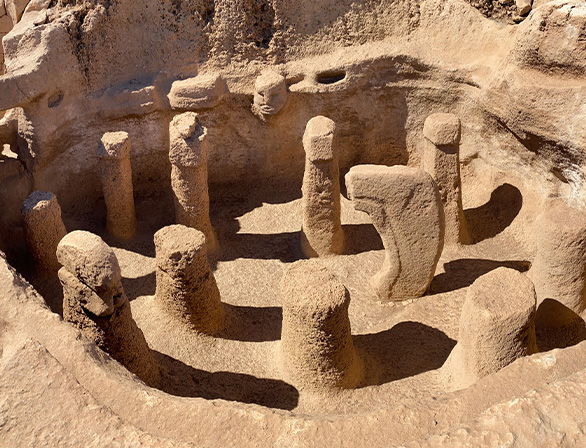
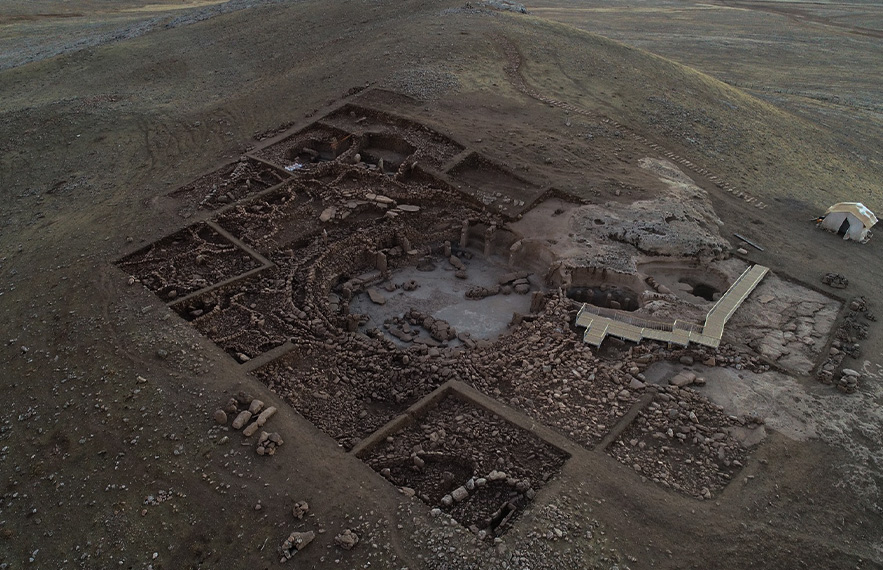
Tek Tek Dağları Milli Parkı içerisinde bulunan KarahantepeKarahan Tepe, located within the Tek Tek Mountains National Park, was discovered in 1997 and excavations began in 2019. Containing more than 250 visible megaliths similar to those at Göbeklitepe, Karahantepe spans an area of 140,000 square meters.
Karahantepe, like Göbeklitepe, is one of the Neolithic settlements in the Harran Plain that shares similar characteristics. Located close to each other, Karahantepe and Göbeklitepe are visible to one another on clear days. It is known that many game animals lived in these areas during prehistoric times. The most prominent remains of these settlements are large, circular structures fixed to the ground and containing T-shaped pillars. Ongoing excavations at Karahantepe will continue to provide us with invaluable clues for understanding the Neolithic period.
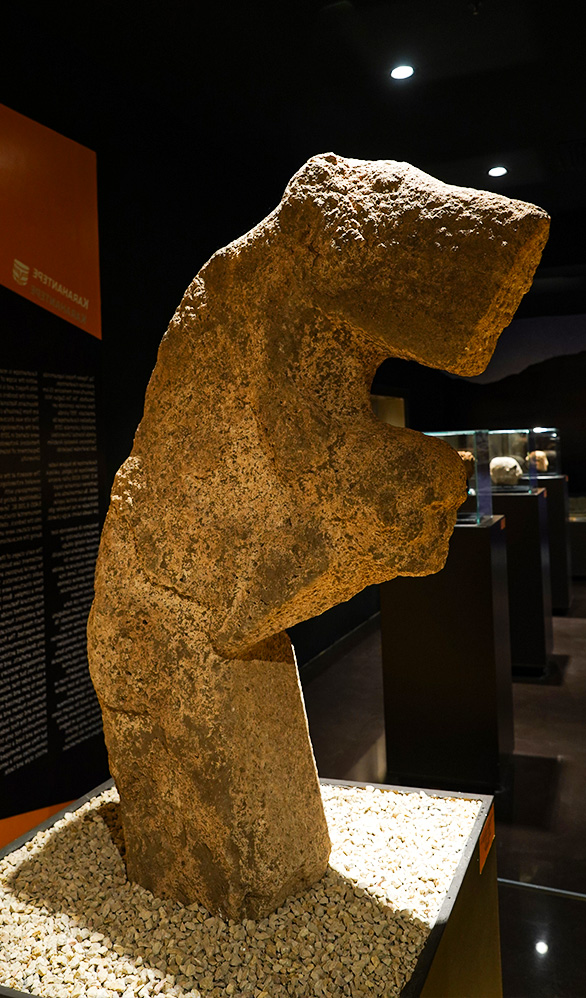
Prof. Dr. Necmi Karul Excavations at Karahantepe, led by Prof. Dr. Necmi Karul, have unearthed four different structures and numerous sculptures, including a statue of a human carrying a leopard on its back. The findings can be viewed at the Şanlıurfa Archaeology Museum. Surface surveys and geomagnetic measurements indicate that Karahantepe holds a wealth of discoveries that will nourish us for centuries to come. A recently discovered complex consisting of a snake-bodied human head carved from the bedrock and standing stones is just one example of this richness.

Remnants of Social Memories in Karahantepe
Today, we live a life far more advanced than the elements that defined the lives of prehistoric humans. Although our similarities outweigh our differences, the influences of the modern world, which surrounds us and which we often accept as the ultimate reality, sharply separate us from the world of prehistoric humans. In other words, our current perception of the world poses a significant obstacle to understanding past societies. This is why archaeology relies on concrete evidence. Evidence, although it has been filtered through thousands of years and has reached us in a diminished form, is a tool that reveals that life in the past was at least as colorful as it is today. However, concrete evidence regarding the beliefs of prehistoric societies is less abundant and more ambiguous than in other areas; therefore, we often prefer to attribute things we find difficult to explain to beliefs as the quickest way possible.
However, considering the difficulties in defining even living beliefs, it is possible to see this as a consequence of oversimplification. Therefore, as we go further back in history, to pre-literate times, what can be said about beliefs remains hypothetical in many respects.
This article discusses two themes found in almost every part of the ancient world, particularly in early settled societies, that may be related to medicine. These are identified as ‘burying the place’ and preserving objects in places that can be considered products of social memory. The article is also limited to the first known actors in these practices: the early settled hunter-gatherer societies. It is accepted that hunter-gatherer societies lived much more closely intertwined with their living environment than later periods, drawing sustenance from all aspects of their surroundings. However, with settled life, these societies began to radically transform their environment, establishing the first villages.
Burying the Structure
The first settled societies in Anatolia appeared around 10,500 BC, with the oldest known examples coming from Southeastern Anatolia.
These villages, on the one hand, witnessed structural activities that can be considered the birth of architecture, and on the other hand, they bear the traces of the conceptual transformation of space. During this period, meanings beyond function were attributed to buildings; building models, and practices such as burying or burning after emptying the space are among the indicators of this.
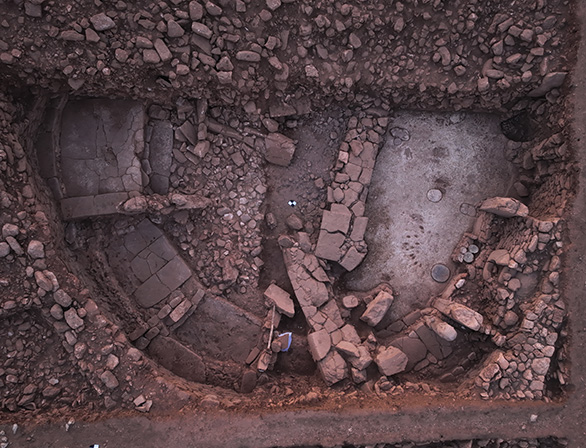
The first observations regarding the burial or, in other words, filling of structures in Anatolia were made at the Can Hasan and Çayönü settlements. While Göbeklitepe reveals the monumental dimensions of this practice, Karahantepe, excavated in recent years, has become one of the best examples reflecting the process of filling structures. At Karahantepe, it has been understood that the specific structures forming parts of a building complex were filled as a result of a series of successive processes. One of these (the AD Structure) has a diameter of approximately 23 meters and was created by cutting into the bedrock, in other words, it was built with the ground embedded. The base of the structure was also created by leveling the bedrock. As in other contemporary examples, this structure also has two central obelisks facing each other, and 17 obelisks placed within the walls at similar intervals. In addition to their symbolic aspects, these obelisks are thought to have served as buttresses supporting the roof. The height of the two central obelisks is approximately 5.5 meters, and the height of the highest buttress on the sides is 4.3 meters. In this way, it is assumed that the obelisks supported a conical roof. These measurements indicate a volume that could be filled with approximately 300 cubic meters of soil. The filling process of this structure began with a deliberate destruction; the two large obelisks in the center were toppled in the same direction, directly onto the base, and shattered upon impact with the ground. Furthermore, the absence of any other fill between the base and the fallen obelisks suggests that the destruction did not occur gradually over time, but rather that they toppled rapidly while the bedrock surface was exposed.
The destruction was not limited to these two obelisks. It is evident from the scattered fragments that the upper parts of the obelisks on the sides were deliberately broken off. Following this destruction, a burial process must have begun. Despite the terrain being sloped in one direction, a central fill of stone and earth, directed towards the center, was observed within this circular-planned space. Large obelisks, dragged here before the space was filled, damaged the building walls and are now hanging precariously on them. Medium-sized stones are also found within the fill in various positions. It appears that these stones were not placed there gradually, but rather as a result of a rapid filling process; they were thrown between the uprights, and in some places, arranged in rows.
The destruction was not limited to these two obelisks. It is evident from the scattered fragments that the upper parts of the obelisks on the sides were deliberately broken off. Following this destruction, a burial process must have begun. Despite the terrain being sloped in one direction, a central fill of stone and earth, directed towards the center, was observed within this circular-planned space. Large obelisks, dragged here before the space was filled, damaged the building walls and are now hanging precariously on them. Medium-sized stones are also found within the fill in various positions. It appears that these stones were not placed there gradually, but rather as a result of a rapid filling process; they were thrown between the uprights, and in some places, arranged in rows.
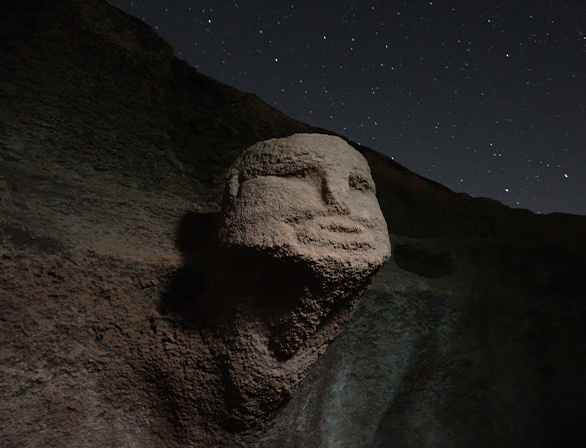
In another structure (structure AB) that is part of the complex at Karahantepe, the burial was carried out without demolition. The dimensions of the structure are approximately 7x6 meters. The more systematic filling process here compared to the larger structure must be related to its smaller size or the meaning attributed to it. On one wall, there is a human head carved from the bedrock, and opposite it, there are 11 phallus-shaped (male genitalia) stones carved from the bedrock in two rows, and a standing stone that was later brought and placed on the ground. Entry to the structure is provided by a staircase from the adjacent larger structure mentioned above; it is understood that exit is via a second staircase at the other end. During the burial process, first, a reddish-brown soil of about 40 cm, containing almost no archaeological material, was filled. Above this level, there is a dark-colored fill containing irregularly shaped stones of different sizes, which also contains archaeological material. During the filling process, it is observed that the shorter obelisks in the back row were raised by placing stones on top of them, and their positions were marked up to the surface level. At the surface level, the structure was covered and closed off with flat stones to define its boundaries.
Both examples at Karahantepe show that the structures were consciously and systematically buried, and although it is understood that objects were deliberately thrown or left inside during this process, it is difficult to make definitive judgments about the reasons for this practice. Undoubtedly, this practice provides insight into the functions and life cycles of the structures. As can be understood from the available examples, although burying a structure implies abandoning a place or location, it is clear that this is a practice requiring too much time and effort to be associated with escape. Indeed, as seen in the Göbeklitepe example, it is known that life continued in the settlement even after the structures were filled and their functions ceased.
Many period experts define the period during which structures are used as their ‘life,’ and their abandonment after being filled, i.e., the completion of their function, as their ‘death.’ Some, with a similar approach, liken the process to the death of a human being, suggesting that structures are imbued with an identity. In any case, the idea that the construction, life, and burial of these structures are parts of the same ritual is worth considering. Another dimension of this ritual is the organization of the workforce required to carry out the process. Ultimately, structures are built to be buried; their end is known, and this thought is the culmination of a societal decision.
Products of Social Memory
Early settled societies, when burying private structures or people, left objects alongside them, essentially preserving them for the future along with their lives. This is also evident in the burial process of private structures. The practice of leaving wall paintings, bucraniums, stone vessels, obelisks, and sculptures in abandoned or filled-in private structures is characteristic of many Neolithic settlements in the Near East.
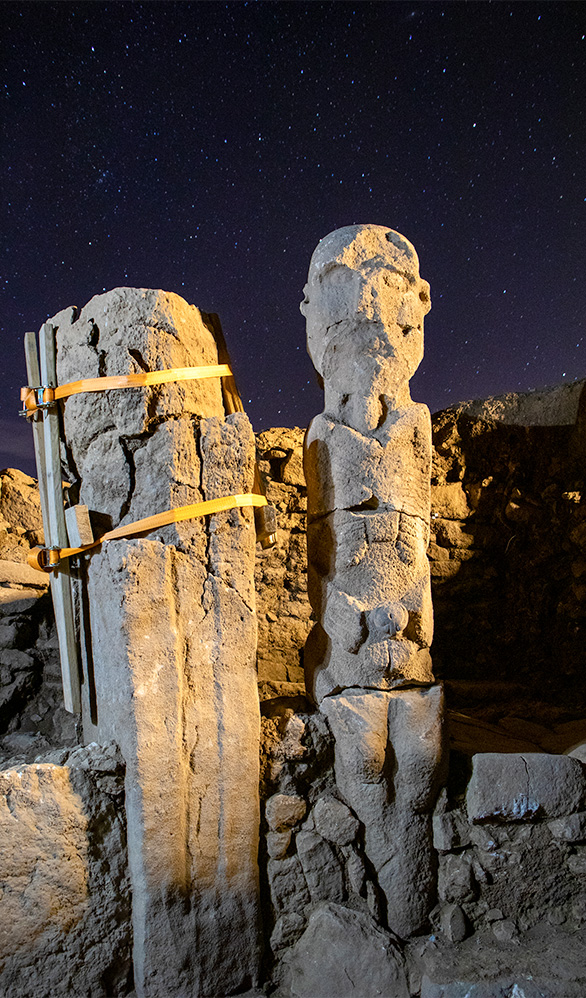
During the filling of the large structure (AD Structure) at Karahantepe mentioned above, numerous fragments of human and animal statues, as well as broken or whole decorated obelisks, were left inside the structure. While most of these finds appear to have been thrown into the space during the filling process, some were carefully placed. Among these, the human head statues left upside down and facing the wall are noteworthy. Additionally, stone plates, some whole and some broken pieces, were left on the lower step of a two-tiered platform or in certain defined areas. On the upper tier of the platform between the two obelisks, stone vessels and a 'totem pole' were found. These in-situ finds on the platform suggest that this area was positioned differently from other parts of the structure during the burial practices.
At Göbeklitepe, the T-shaped megaliths are among the structural elements preserved by burial. The relief carvings, depicting limbs such as arms and hands with anatomical position and proportion, suggest that the megaliths symbolize humanity. These megaliths also served as a kind of "writing board" for prehistoric "storytellers"; animals, geometric motifs, and human depictions are the characters in these "stories." These characters, transformed into symbols, share certain common characteristics, suggesting that the meanings attributed to them were known. Besides the symbols themselves, the scenes they create indicate that what is intended to be conveyed is sometimes more than meets the eye. The discovery of bones belonging to many of the animals depicted in the symbols during excavations is also evidence that the creatures forming the scene and the people who created them shared the same environment. Of course, it is also possible that these symbols were attributed to supernatural beings.
The inclusion of symbols within structures has ensured their integration with the space and their continued existence in the mind through the space itself. It's difficult to know exactly what purpose this serves, but it can be said that as long as they exist, they contribute to the formation of a collective memory, which in turn helps shape the thinking of the individual and the society to which they belong.
As we mentioned at the beginning, there is sufficient evidence to look back at the past by acknowledging that prehistoric humans led a very colorful and diverse life. Undoubtedly, the two issues we have highlighted here are not sufficient for understanding this world. Nevertheless, these practices encountered in early settlements have frequently come to the forefront in recent years and are discussed under the umbrella of religion. However, it is difficult to define what we encounter here as a religion, and this misconception likely stems from the tendency to define rituals by comparing them to religion.